Speed to lead is the time between a guest raising their hand and your venue saying something back. In event sales it is the single number most predictive of whether you win the booking, because the person planning an event almost never inquires with only you.
They fill out three forms in fifteen minutes. Then they wait. Whoever answers first gets the conversation, and the conversation is most of the sale.
How long do venues actually take? In our 2026 study of 807 inquiries, the median wait for a human reply was 23.6 hours, 2 percent were answered within five minutes, and 19 percent never heard from a person at all.
The wider sales research is blunter still. The Lead Response Management Study led by MIT's Dr. James Oldroyd found the odds of qualifying a lead drop 21 times when the first contact slips from five minutes to thirty, and Harvard Business Review found firms that replied within an hour were nearly seven times as likely to qualify the lead as those that waited even an hour longer.
An event inquiry is a moment of peak intent. The planner is at their desk, budget in mind, dates in hand. An hour later they are back in meetings. A day later your reply is one of forty unread emails. The venue that responds while intent is hot inherits everything that follows: the tour, the trust, the contract.
And most inquiries do not arrive during business hours. Forms get filled at night, on weekends, during lunch breaks. A team that answers fast from nine to five is still silent when much of the demand shows up.
Ask any events team their response time and you will hear an optimistic answer. Measure it instead. Pull your last 90 days of inquiries and check three things: the median time to first reply, the share of leads that never got a reply at all, and the share that arrived outside business hours. The second number is the one that stings. Silent losses do not show up in anyone's inbox, which is why the cost of the delayed reply stays invisible until you count it.
An autoresponder technically replies in seconds and wins nothing. What moves bookings is a real answer: a message the guest can respond to, questions that move the event forward, and a concrete next step. That is why the better metric is speed to confirmation: the minutes from inquiry to a booked tour, call, or held date. Speed to lead opens the door. Speed to confirmation walks through it.
A fast email can still lose to a slower text, because email is where event inquiries go to be ignored: spam filters, promotions tabs, mornings that bury it. Texting meets the guest where their attention already is, and keeps the conversation moving in minutes instead of days. This is why SMS outperforms email for first contact with event leads.
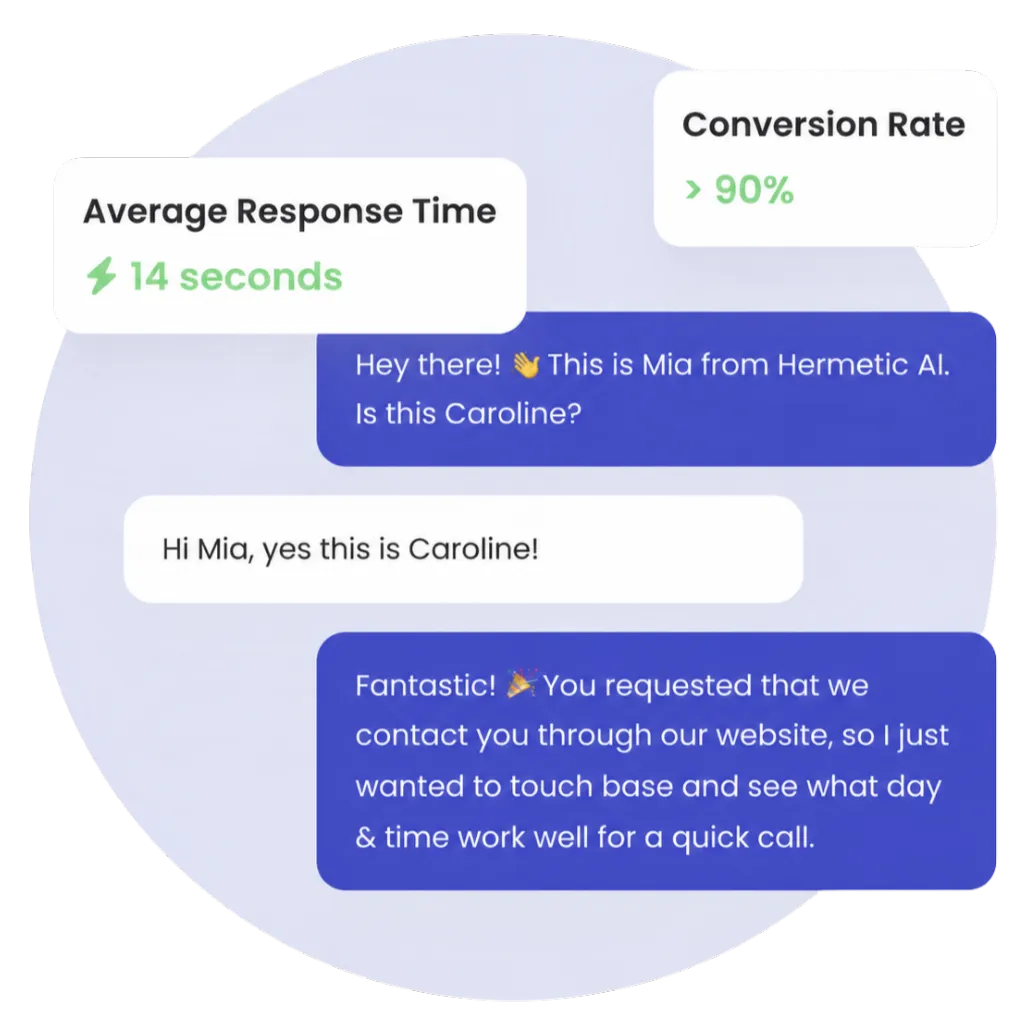
No schedule change and no new hire gets a human team to seconds around the clock. This is the one part of the job that belongs to software. Mia answers event inquiries within about 13 seconds, by text, 24/7, qualifies the lead in conversation, and books the tour against your real calendar. Your team starts their morning with responded leads instead of a backlog. One of the biggest honky-tonk venues in Nashville put instant response in front of its inbound and event conversions rose 38.4%, worth $2.03M in event revenue.
Decide what your first five minutes look like, because your guests already have. Measure the real number, fix the channel, and let software own the seconds so your team can own the close.
Events are not won at the tasting. They are won at hello.
This article is part of our guide to Speed to Lead: benchmarks, statistics, and why response time decides who wins.