AI event management means using an AI agent to run the repetitive, time-sensitive parts of a venue's event operation: answering inquiries the moment they arrive, qualifying leads, routing them to the right seller, booking tours and calls, following up, and producing event paperwork. The parts that need judgment, taste, and relationships stay with your team. This guide walks the full event-lead lifecycle and shows where AI genuinely helps at each stage.
Every event starts as an inquiry: a web form, a call to the events line, an email from a lead source. This is the most fragile moment in the whole lifecycle, because the planner who just asked you is usually asking two or three other venues in the same sitting.
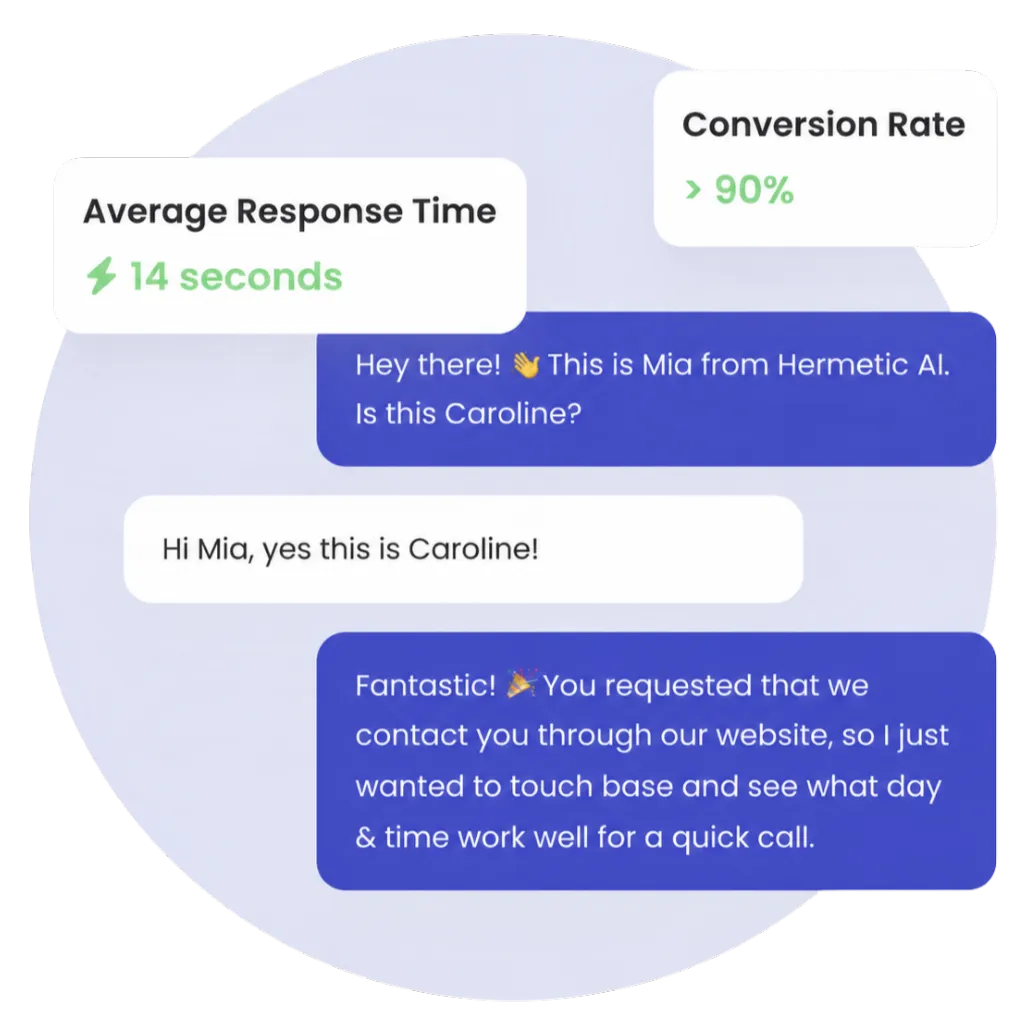
An AI agent removes the gap entirely. Mia replies in about 13 seconds, by text, 24/7, so the inquiry that lands at 11 PM on a Saturday gets the same instant welcome as one that lands mid-morning on a Tuesday. Phone inquiries get the same treatment: a voice agent answers the events line, captures the details, and hands the conversation to text.
The gap it removes is not small. In our 2026 study of 807 inquiries, the median venue took 23.6 hours to put a person on a new inquiry, and only 41 percent were answered within a day.
Across industries the pattern holds. In the Harvard Business Review audit of 2,241 companies, the average response to a web lead took 42 hours and 23 percent of companies never replied.
Date, headcount, budget, occasion, room requirements. Collecting these by email takes days of back-and-forth; collecting them in a text conversation takes minutes. AI qualification happens inside a natural conversation, so the guest never feels interrogated and your team never opens a lead cold. Junk and mismatched inquiries get filtered before they cost a coordinator any time.
In multi-venue groups and larger properties, the right seller depends on location, event type, and workload. AI lead routing applies those rules in real time, round-robin or weighted, so every qualified lead lands with the right person immediately instead of sitting in a shared inbox waiting to be claimed.
The classic failure here is the scheduling link that never gets clicked. An agent does the negotiating instead: it reads your team's real calendar availability, proposes times in the conversation, books the tour or call, and sends invites to both sides. Appointment setting is where speed turns into a calendar full of qualified meetings.
Most event leads do not book on the first exchange, and most venues stop following up after one or two attempts. An agent does not get busy or embarrassed about the fourth follow-up. Long-term nurture keeps working quiet leads, flags the unresponsive ones back to your team, and re-engages past inquiries and previous guests when they are likely to book again, which is outreach almost no events team has time to do by hand. Velocify's analysis of almost 3.5 million leads found 93 percent of the leads that eventually converted were reached by the sixth attempt.
Once an event books, the operational documents begin: the banquet event order, the menus, the confirmations. AI helps here too. Menu generation turns the BEO into branded, print-ready event menus automatically, taking a recurring production task off the events team entirely.
A good AI event operation is defined as much by handoffs as by automation. The walkthrough, the negotiation, the upsell to the bigger room, the VIP who expects a familiar name: those belong to your team. The agent's job is to make sure your team spends its time there, instead of on first replies and date checks. Two useful reads on drawing that line: when AI should pass an inquiry to a human and the three inquiries your AI should never answer.
The point of all six stages is conversion of demand you already have. Hermetic customers tell it in their own numbers in our customer stories: one location of a Washington, DC restaurant group grew private event revenue 400 percent, a Boston restaurant group lifted event revenue 170 percent, and one of the biggest honky-tonk venues in Nashville grew to $2.03M in event revenue.
The FAQ answers the practical questions venues ask before starting, from control over what the agent says to how conversations stay visible to your whole team. Or watch Mia handle a live inquiry end to end.
This article is part of our guide to Hospitality Event Sales: how event leads work and how venues convert more of them.